
By: ResponsibleAI Labs
Overview
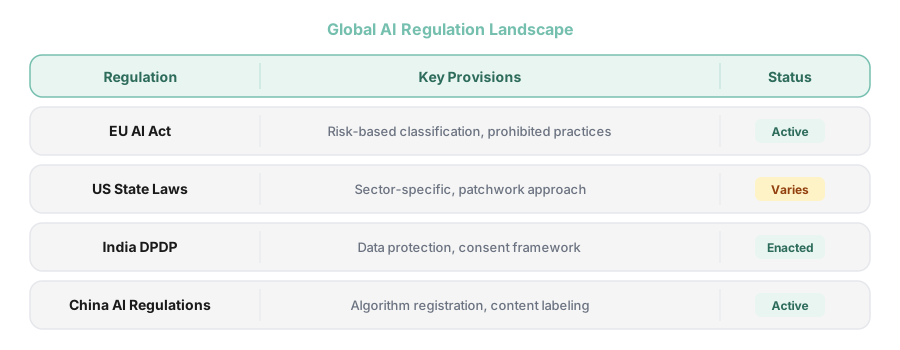
Seventy-two countries now have AI policies. All 50 US states have introduced AI legislation. The EU AI Act's most consequential enforcement phase kicks in this August. And a newly assertive White House is seeking to preempt state laws in the name of global competitiveness.
The Global Picture: From Debate to Enforcement
The era of debating whether AI needs regulation is over. According to the OECD, 72 countries have adopted some form of AI policy, though most have not yet translated these into legally binding law. The EU AI Act remains the world's only comprehensive, risk-based AI regulation with binding enforcement and significant penalties. However, South Korea and Japan enacted dedicated AI laws in 2025, China continues expanding sector-specific regulation, and US states are legislating at extraordinary pace.
As the IAPP observed: "A more recent trend has been to temper regulatory limits on the technology in the name of competition and innovation." The tension between protecting citizens from AI harms and maintaining competitive advantage defines global AI policy in 2026.
Jurisdiction-by-Jurisdiction Overview
European Union: The Gold Standard, Under Pressure
The EU AI Act, passed in 2024, remains the most ambitious AI regulation globally. Its risk-based framework classifies AI systems into four tiers -- unacceptable, high-risk, limited, and minimal -- with scaled obligations.
Enforcement Timeline:
Article 50's transparency obligations also become enforceable on August 2, 2026, requiring machine-readable marking of AI-generated content and clear disclosure of deepfakes. Maximum penalties reach EUR 35 million or 7% of global annual turnover, whichever is higher.
European leaders began considering implementation pauses in early 2026 due to competitive concerns against less-regulated US and Chinese competitors. The Code of Practice on AI-generated content transparency's final version was expected by mid-2026.
United States: The Fragmentation Accelerates
The United States has no comprehensive federal AI law. The regulatory landscape features three competing forces: an executive branch seeking deregulation, Congress moving toward children's safety legislation, and states legislating rapidly.
Federal Level:
On December 11, 2025, President Trump signed "Ensuring a National Policy Framework for Artificial Intelligence." The executive order signals intent to consolidate AI oversight federally, counter state-level rules, and maintain US global AI dominance. It created a DOJ litigation task force to challenge state AI laws deemed overly burdensome and recommended prohibiting states from regulating AI development.
The White House's March 20, 2026 AI policy recommendations prioritize children's online safety, intellectual property, AI literacy, and state law preemption. Senator Marsha Blackburn introduced a discussion draft combining the Kids Online Safety Act with the NO FAKES Act.
State Level:
Despite federal pushback, states continue legislating aggressively. In 2025, all 50 states, Puerto Rico, the Virgin Islands, and Washington DC introduced AI legislation. Thirty-eight states adopted approximately 100 measures.
Key examples include:
Connecticut, Massachusetts, New Mexico, New York, and Virginia are considering bills tracking Colorado's approach, potentially establishing it as a template for comprehensive state AI governance.
China: Prescriptive and Expanding
China pursues a fundamentally different approach: sector-specific, prescriptive, and focused on content control. Rather than comprehensive law, China built a layered regulatory apparatus covering:
The amended Cybersecurity Law, enforceable since January 1, 2026, adds AI security review and data localization requirements. A draft Artificial Intelligence Law proposed in May 2024 could create comprehensive regulation, though China's regulatory philosophy prioritizes national and social interests over individual rights, fundamentally differing from the EU's rights-centric model.
United Kingdom: Sector-Specific, But Evolving
The UK remains without AI-specific legislation, pursuing sector-by-sector approaches where existing regulators interpret and enforce AI principles within their domains. However, pressure is building. A Private Member's Artificial Intelligence (Regulation) Bill was reintroduced in early 2026 and is progressing in the House of Lords. The Data (Use and Access) Act 2025 and the Online Safety Act provide indirect AI governance.
Notably, the UK and US declined to sign a declaration at the 2025 AI Safety Summit promoting "inclusive and sustainable" AI -- a declaration endorsed by 60 other countries -- signaling prioritization of innovation over regulation.
Asia-Pacific: A Spectrum of Approaches
South Korea enacted its AI Framework Act in January 2026, establishing one of the world's more comprehensive frameworks with mandatory fairness and non-discrimination requirements across high-impact sectors, AI content labeling, and promotional measures. Administrative fines can reach approximately $21,000.
Japan's AI Promotion Act (May 2025) takes a deliberately light-touch approach: encouraging company cooperation with government safety measures and empowering the government to publicly name companies violating human rights through AI, but imposing no monetary penalties.
India is developing a proposed Digital India Act updating its regulatory regime for AI-generated content, but no binding AI-specific law is yet in force.
Singapore continues with its voluntary Model AI Governance Framework, focusing on practical guidelines rather than binding requirements.
Emerging Frameworks
Brazil's Bill No. 2338, approved by the Senate in December 2024 and closely aligned with the EU AI Act, would create a risk-based AI framework. Vietnam's Draft Law on AI emphasizes human-centrism and risk-based management. Argentina has proposed a Bill on Personal Data Protection in AI Systems.
Key Themes for 2026
From Voluntary to Mandatory
The global trend unmistakably moves toward binding requirements with real enforcement teeth. Even jurisdictions starting with voluntary guidelines are shifting toward mandates -- a change the EU AI Act accelerated.
Risk-Based Classification Is Winning
The EU's tiered approach -- with escalating obligations based on AI system risk level -- has been adopted or adapted by South Korea, Brazil, Colorado, and others. It emerges as the closest global standard.
Children's Safety as Common Ground
In an otherwise polarized policy environment, protecting children from AI harms represents rare bipartisan, cross-jurisdictional consensus. The US, EU, UK, Australia, and South Korea have all prioritized it.
Transparency as Baseline
Across all major jurisdictions, disclosure requirements -- telling users when interacting with AI, labeling AI-generated content, documenting training data -- are becoming minimum regulatory expectations.
The Preemption Battle
In the US, clashing federal deregulation desires and state-level activism create legal uncertainty. This power struggle's outcome shapes not only US AI governance but global compliance expectations for cross-border companies.
Agentic AI as the Next Frontier
As AI systems shift from responsive tools to autonomous agents capable of independent action, existing regulatory frameworks -- designed for human-supervised systems -- face fundamental gaps. Experts expect 2026 to see first serious proposals governing agentic AI.
What Organizations Should Do
Map Your Jurisdictional Exposure
The EU AI Act applies extraterritorially -- if your AI affects EU residents, you must comply regardless of headquarters location. Similar logic applies to California, Colorado, and other state laws with broad applicability.
Prepare for August 2, 2026
The EU AI Act's Phase 3 deadline is 2026's single most consequential compliance event. Organizations with high-risk AI systems need conformity assessments, risk management systems, technical documentation, and transparency mechanisms ready.
Build Governance Infrastructure Now
Risk assessments, model documentation, bias auditing, and human oversight protocols are becoming multi-jurisdictional requirements. Investing in infrastructure once -- rather than building jurisdiction-specific solutions -- is more efficient and defensible.
Monitor the US Federal-State Dynamic
The executive order's preemption attempt does not automatically override state laws. US companies should comply with applicable state laws while tracking federal developments.
Treat Transparency as Non-Negotiable
Every major jurisdiction requires some AI transparency form. Organizations building disclosure, labeling, and documentation into products from the start position themselves better than those retrofitting compliance.
Conclusion
The 2026 AI regulatory landscape is simultaneously more comprehensive and more fragmented than ever. The EU leads with binding, rights-based frameworks. The US remains caught between federal deregulation and state-level activism. China builds prescriptive apparatus focused on content control and national interests. Asia-Pacific nations chart diverse paths from comprehensive law to light-touch guidance.
For organizations, the message is clear: AI governance is no longer optional, and compliance complexity will only grow. Companies succeeding will treat regulatory requirements not as innovation obstacles but as maturing industry structural features -- ones where accountability, transparency, and fairness are as essential as capability and performance.
References
This article is part of ResponsibleAI Labs' 2026 series on emerging AI ethics and risk.