How RAIL Score acts as a continuous safety layer for AI applications, catching issues before they reach users.
RAIL Team
October 25, 2025
10 min read
RAIL Score as a real-time safety layer in production AI
Without RAIL monitoring
✗Harmful responses reach users
✗Bias detected only post-incident
✗Manual audit every quarter
✗Issues found in production
With RAIL monitoring
✓Responses evaluated before delivery
✓Bias flagged per request, in real time
✓Continuous automated audit trail
✓Issues caught at the gate, not in prod
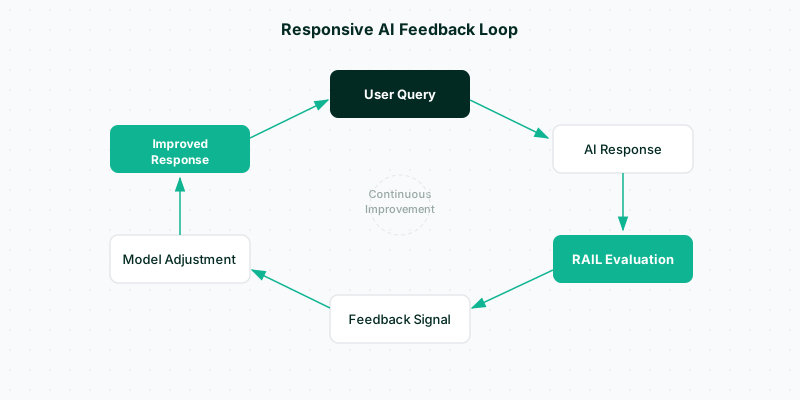
RAIL Score feedback loop
How the RAIL Score ensures AI systems are not just fast and powerful, but also safe, fair, and accountable
What Do We Mean by "Responsive AI"?
Responsive AI marks a major shift in how we engage with technology.
Previous AI systems depended on strict rules or set guidelines, which frequently fell short in unexpected situations. Responsive AI employs machine learning and data insights to quickly adjust to user inputs, preferences, and changing circumstances. It aims to create AI that comprehends human intent and alters its actions accordingly, enhancing interactions to be not just smarter but also safer and more significant.
Now, compare this with the irresponsible responses from AI. When businesses prioritize speed and profits over ethics, the outcomes can lead to harmful, biased hiring choices, unsafe healthcare recommendations, or customer service bots that annoy instead of assist. These are not merely lost chances; they undermine trust and emphasize the dangers of neglecting AI safety management.
Responsive AI is already reshaping industries:
Healthcare: It analyzes patient data, monitors vital signs, and recommends timely treatment adjustments, strengthening both care and AI in safety management. But without attention to fairness, bias in medical datasets can reinforce inequities, raising urgent questions about ethics in the age of generative AI.
E-Commerce: Retailers improve customer experiences by offering personalized suggestions and predictive shopping insights. However, a strong dependence on personal data creates issues related to privacy, transparency, and the clarity of AI.
Finance: Banks use responsive AI for real-time fraud detection and adaptive financial advice. Still, when firms prioritize irresponsible AI responses over clarity, customers struggle to trust AI responses that lack transparency, even if they appear profitable.
Customer Service: Generative AI chatbots now understand concerns and solve problems quickly. However, without proper safeguards, these AI-generated responses might change in ways that annoy users, highlighting how poorly managed systems can fail.
Education: In classrooms, adaptive AI tailors lessons to the strengths and weaknesses of students, fostering inclusivity. Yet, depending too much on it without accountability can lead to unintended effects, ranging from AI in workplace safety to wider societal consequences.
In the end, the very traits that give Responsive AI its strength can also create dangers if not managed properly. Creating genuinely responsive AI focuses on both technical efficiency and accountability.
It is clear that responsive AI has great potential, but without a standard to assess safety, fairness, and accountability, risks can go unchecked. This is why the RAIL Score is crucial.
At RAIL, we think that transparency, ethics, and accountability are essential; they form the basis for AI that adjusts while ensuring safety.
What Makes the RAIL Score AI's Safety Belt?
The RAIL Score, created by Responsible AI Labs, serves as a report card for AI systems. It assesses AI-generated content based on eight key dimensions that represent both technical performance and responsibility. As real issues in AI safety emerge every day, companies, developers, and regulators require a standard like the RAIL Score now more than ever. It functions as an AI safety belt, promoting transparency, reliability, and trust in the interactions between systems and people.
By embedding transparency and explainability into its framework, the RAIL Score helps identify risks early on, guiding businesses toward responsible deployment rather than reactive damage control.
Breaking Down the 8 Dimensions of the RAIL Score:
Fairness: "Fairness guarantees that AI does not show bias against race, gender, or socio-economic status." For instance, in hiring systems, fairness stops unfair candidate selection. Without fairness, careless actions by AI companies can increase inequalities rather than address them.
Safety: AI in safety management requires careful attention. This aspect stops the system from generating harmful, toxic, or dangerous results. Consider a healthcare chatbot: if it suggests unsafe treatments, the outcomes can be serious. RAIL's safety measures lower the risks that might threaten human lives.
Reliability: "AI needs to be reliable and consistent, avoiding any conflicting advice or false information." In the context of workplace safety, where a system oversees factory equipment, dependability guarantees that alerts are always correct. A single wrong or inconsistent signal could determine whether safety is maintained or an accident occurs.
Transparency: Transparency provides clarity in AI, allowing users and regulators to understand the reasons behind a system's decisions. For instance, in finance, customers have the right to know the reasons for a loan denial, rather than just getting an unclear AI response.
Privacy: With generative AI in customer service or healthcare assistants, sensitive personal data often flows into the system. Privacy ensures no leaks, misuse, or unintended exposure of this data. In healthcare, safeguarding patient data isn't just ethical, it's legally required.
Accountability: When AI systems create false information or lies, who is to blame? Accountability makes sure there is a clear line of responsibility and that false content is identified before it circulates. For example, in journalism or business reporting, this rule stops AI from spreading unverified falsehoods.
Inclusivity: AI should not serve only a narrow demographic. Inclusivity ensures content works across languages, cultures, and accessibility needs. In education, for example, responsive AI can adapt lessons for differently abled students, ensuring no learner is left behind.
User Impact: Beyond technical output, AI responses have emotional and practical effects. In customer service, a chatbot should empathize, reassure, and resolve, leaving customers satisfied, not frustrated. This dimension measures whether AI builds trust or erodes it.
The RAIL Score uses a smart system that gives a score from 1 to 10 for each aspect, with weights reflecting their significance for a specific use case. It's not a one-size-fits-all rating; it's flexible, built with tools like bias detectors and toxicity filters to examine the details.
Why the RAIL Score Matters Now
AI is no longer a futuristic concept; it's already deciding who gets medical care first, approving loans, or chatting with customers online. But here's the challenge: trust is eroding. Studies show that a majority of people worry about AI spreading misinformation, and real-world risks are no longer hypothetical.
The RAIL Score is built to tackle concrete problems in AI safety, and it helps companies balance innovation with ethics. By weighing dimensions like privacy in healthcare, fairness in finance, and user impact in customer service, the RAIL Score adapts to each use case instead of offering a one-size-fits-all grade.
For businesses, it acts as a trust badge -- proof that their AI is high-performing and also transparent, inclusive, and safe at the same time. For regulators, it provides a compliance-ready tool that translates principles like transparency and explainability into measurable standards.
The RAIL Score matters now because it bridges the growing trust gap, making AI not just powerful, but also responsible, reliable, and regulation-ready.
What Are the Benefits of the RAIL Score?
The impact of the RAIL Score goes beyond theory; it delivers value across the entire AI ecosystem:
For Developers: It serves as a diagnostic tool that helps find gaps in fairness, reliability, or safety. By assessing performance across 8 dimensions, developers can refine their models, minimize real issues in AI safety, and create more adaptable, transparent systems.
For Businesses: In a market where customers are wary of poor AI assistant responses, the RAIL Score functions as a trust badge. It proves that their AI isn't cutting ethical corners, giving them a competitive edge while strengthening brand credibility.
For Regulators: The RAIL Score provides measurable, standardized benchmarks for transparency and explainability in AI. This makes it easier to hold organizations accountable, ensure compliance, and align with global AI safety regulations.
For Everyday Users: Ultimately, the greatest benefit flows to the end user. By flagging biases, hallucinations, and unsafe content, the RAIL Score ensures AI interactions are safer, more reliable, and far less frustrating -- whether it's customer service, healthcare apps, or financial tools.
The RAIL Score enables developers, businesses, regulators, and users to create a safer and more responsive AI environment for all.
AI may be everywhere, but with tools like the RAIL Score, we can make sure it's everywhere responsibly.
Key Takeaways
AI is now the focus of every headline and pitch deck, as vendors compete to present their newest AI-driven solutions
At its core, Responsive AI represents a paradigm shift -- moving from static rules to dynamic systems that learn, interpret, and adjust in real time to user intent
The RAIL Score acts as a report card for AI, assessing both smart and responsible answers
It seeks to address real issues in AI safety, helping companies align innovation with ethical standards
It uses a smart system that gives a score from 1 to 10 for each aspect, with weights reflecting their importance for a specific use case