
“The India AI Impact Summit 2026 highlighted how rapidly AI is evolving. During the event, Responsible AI Labs (RAIL) engaged with developers, enterprises, students, and policymakers to demonstrate how AI systems can be evaluated, monitored, and governed responsibly. The conversations throughout the summit revealed a growing awareness that as AI scales across society, safety, accountability, and trust must evolve alongside innovation.”
The turnout at the AI Impact Summit in New Delhi demonstrated a strong interest in Artificial Intelligence (AI) technologies among digitally connected Indians.
While AI companies often highlight India as the largest user base outside the U.S., the large crowds throughout the week clearly showed how eager many Indians are to embrace this technology.
Importantly, the summit continued a series of annual multilateral AI discussions, with 89 countries signing a declaration outlining voluntary commitments to share knowledge on AI democratization.
For India, this moment represents more than just growing adoption. It signals an opportunity to shape how AI is built, deployed, and governed in ways that align with the country’s economic ambitions, technological capabilities, and societal priorities.
About India AI Impact Summit 2026
The India AI Impact Summit 2026 was a global event focused on artificial intelligence (AI) that took place in New Delhi from February 16 to 21, 2026.
This summit is the fourth in a series of worldwide AI summits following the ActionSummit" class="text-blue-600 hover:text-blue-700 underline font-medium" target="_blank" rel="noopener noreferrer">AI Action Summit in Paris in February 2025, the 2024 SeoulSummit" class="text-blue-600 hover:text-blue-700 underline font-medium" target="_blank" rel="noopener noreferrer">AI Seoul Summit, and the Bletchley Park SafetySummit" class="text-blue-600 hover:text-blue-700 underline font-medium" target="_blank" rel="noopener noreferrer">AI Safety Summit in 2023.
The India AI Impact Summit 2026 was based on three main pillars, called 'Sutras', a Sanskrit term meaning guiding principles or key threads that connect wisdom and action. These three Sutras, namely People, Planet, and Progress, outline how AI can be utilized through multilateral collaboration for the common good.
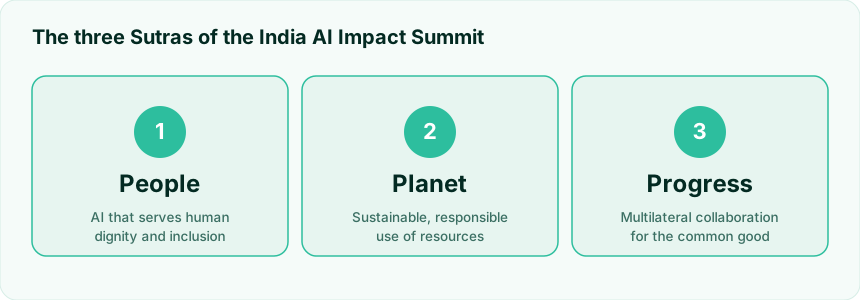
The AI Impact Summit discussions centered on the three main Sutras and focused on seven connected Chakras. These Chakras represented areas for multilateral cooperation to channel collective energy towards significant societal change.
Now, let’s answer the question... “Why this summit matters?”
India’s AI moment reflected how quickly conversations around Artificial Intelligence are moving from policy announcements to real-world adoption, governance, and responsible deployment.
Events like this matter because they bring together policymakers, startups, developers, enterprises, and educators to shape how AI will be built and used in society.
For emerging startups working in responsible AI infrastructure, the summit also created an important opportunity to engage directly with this evolving ecosystem.
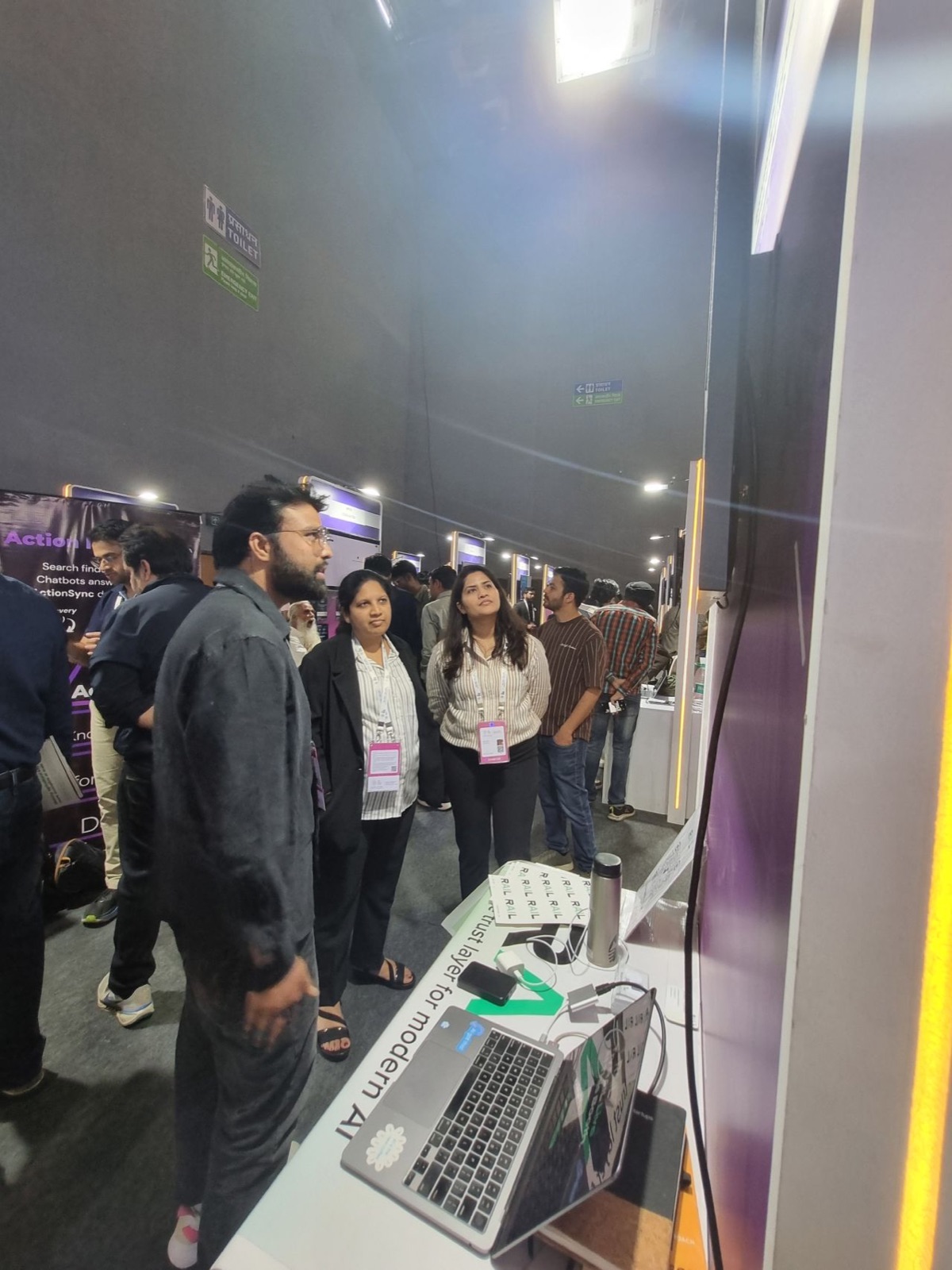
Responsible AI Labs (RAIL) joined the summit as one of the startups contributing to this broader conversation, showcasing how AI systems can be evaluated, monitored, and aligned with safety and governance standards as adoption continues to grow.
What Did RAIL Showcase to Developers and Policymakers?
At our booth, attendees were guided through the live platform experience on the Responsible AI Labs website. After a simple sign-up and email verification process, users land on a dashboard with 100 free credits every month, allowing them to immediately test and evaluate AI outputs.
This hands-on access was especially engaging for young students and first-time AI users who wanted to understand how safety evaluation actually happens behind the scenes.
RAIL provides structured AI safety solutions for both developers and non-technical stakeholders:
For Non-Technical Users: No-Code Safety Tools
We showcased four core tools designed for accessibility:
For Example, we demonstrated how the Compliance Tester works
Step 1: Paste the Content
Users begin by pasting the AI-generated output (for example, a medical advisory response) into the Compliance Tester input field.
Step 2: Select the Regulatory Framework
Next, they choose the framework against which they want to evaluate the content. Options include:
Step 3: Add System Context (For Higher Accuracy)
To improve precision, users can provide additional details such as:
This ensures the audit reflects real regulatory expectations rather than a generic check.
Step 4: Choose Evaluation Settings
Users can:
Step 5: Run the Compliance Audit
Within seconds, the dashboard generates:
For Developers: API & SDK Integration
For technical teams, RAIL demonstrated seamless integration capabilities.
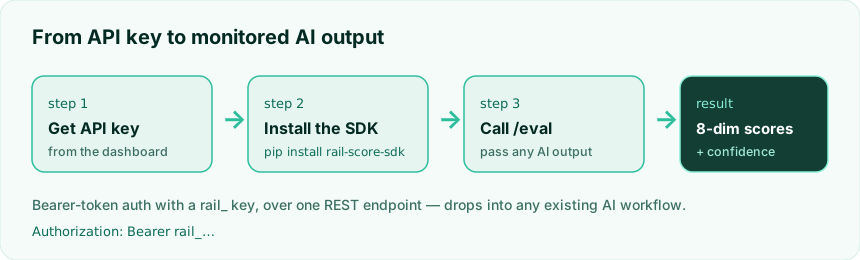
Developers can generate an API key directly from the dashboard and access full API documentation via the “View API References” section. The platform offers Python SDK (rail-score-sdk), along with provider integrations and wrappers, including OpenAI, Anthropic, and Google Gemini integrations.
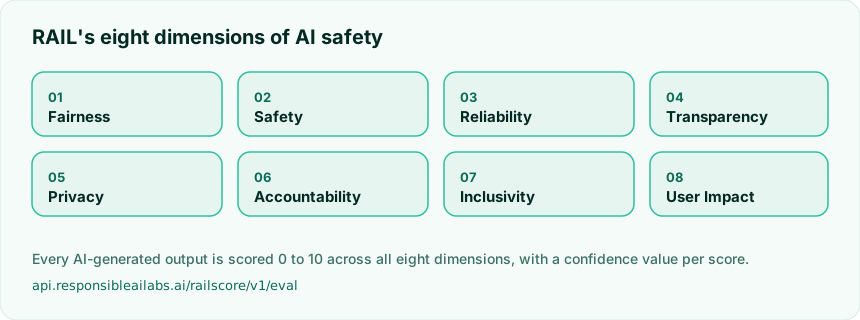
Once installed, developers simply initialize the RAILScoreClient with their API key and begin evaluating content programmatically. Any AI-generated output passed through the API can be assessed across RAIL’s eight safety dimensions, enabling automated monitoring within existing AI workflows.
How Did RAIL Address the Eight Dimensions of AI Safety During the Event?
When we walked into the India AI Impact Summit 2026, we intended to speak to enterprises about compliance, monitoring, and safe AI deployment. The expectation was that most conversations would revolve around governance frameworks, evaluation pipelines, and production-readiness.
But what unfolded was different...
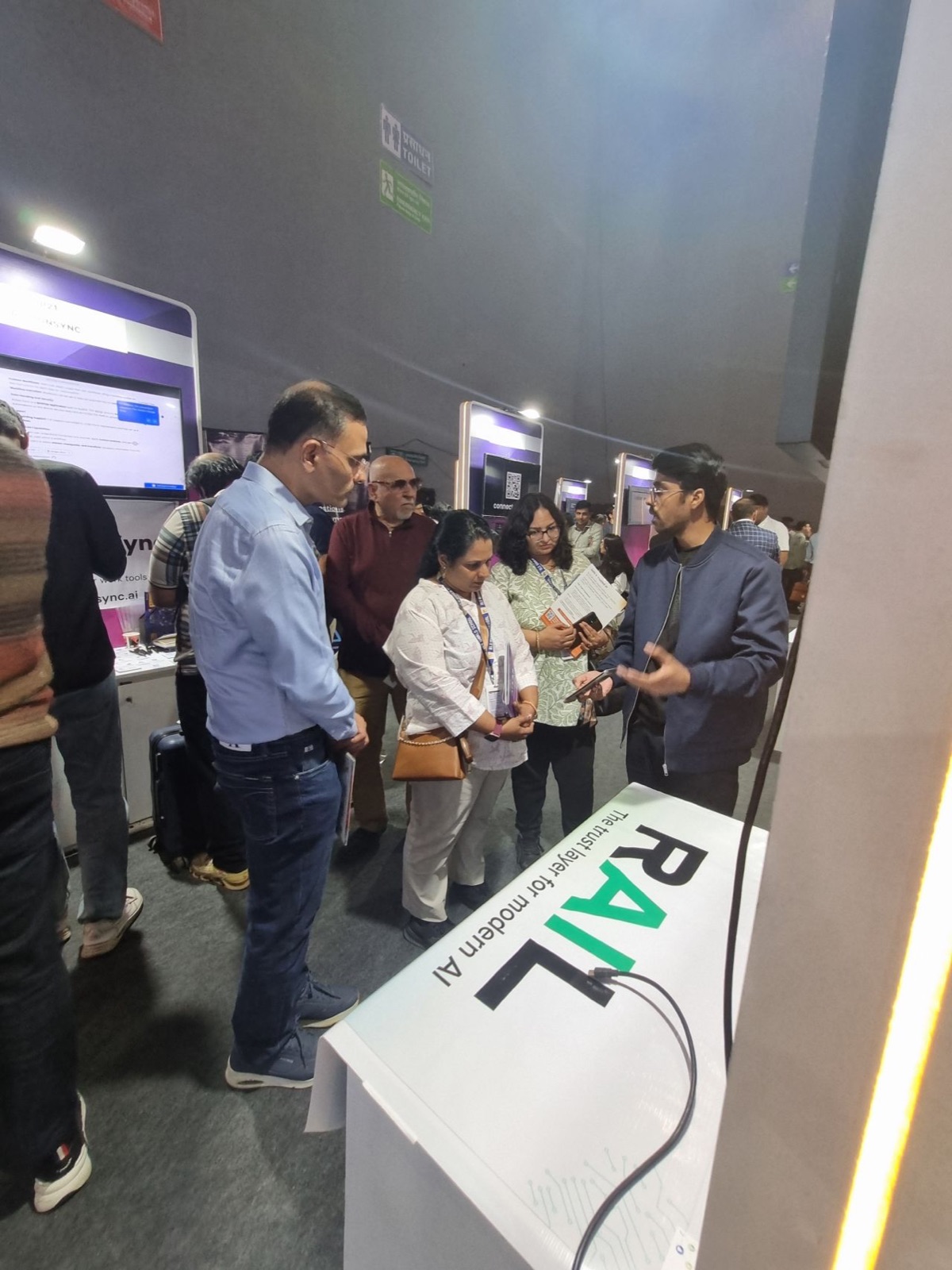
As our CEO, Sumit Verma reflected, people who stopped by our booth were not only enterprise leaders but also students, teachers, and even parents. All of these different groups shared one thing in common - safety concerns around AI.
To give you an example, we would like to share an incident shared by our Sumit. He told us that a parent visited our booth who told him that she has been using an online medical tool to seek advice for her child, who has special health needs.
What started as a general discussion gradually turned into a more serious conversation.
Sumit then explained the risks of depending on tools that may provide unverified or inaccurate medical information. Without professional oversight or proper validation, such tools can sound confident while still presenting incomplete or misleading guidance.
Whether we were speaking with business leaders evaluating new systems, educators considering classroom use, or parents navigating digital tools at home, the conversations consistently returned to one central theme: the need for safety, accountability, and trust.
Ultimately, nearly every discussion circled back to the eight-dimensional framework of RAIL:
What Were the Biggest Achievements for RAIL at the India AI Impact Summit 2026?
At the summit, there was a strong focus on how AI users receive responses that are fair and unbiased, along with growing interest in governance frameworks and safety measures.
Attendees paid close attention to risks such as incorrect data outputs, hallucinations, and harmful responses that could impact real users.
The concern among attendees was real and widespread. Through RAIL’s structured evaluation and monitoring framework, we showed how these risks can be systematically identified, measured, and reduced.
Our booth drew significant interest because the conversations at the summit had shifted. Safety, monitoring, and accountability were no longer side topics; they had become central to how organizations think about AI deployment.
Even before the summit, RAIL had already been building strong momentum:
Being at the India AI Impact Summit 2026 amplified that traction in a completely new way.
The quality of conversations, the level of enterprise interest, and the validation we received on the ground stood out.
We also welcomed several new users during the summit, reinforcing that demand for governed, enterprise-ready AI is growing rapidly. These numbers show that structured AI evaluation is already moving into practice.
Beyond visibility and traction, the summit offered something deeper. As Sumit noted, the experience highlighted an important understanding: Responsible AI cannot stay confined to corporate boardrooms. Safety frameworks must translate into awareness, practical application, and accountability for everyone engaging with AI systems.
A note from Sumit Verma, Co-founder and CTO
Like most startups, we went to India AI Impact Summit 2026 with a clear intention. Speak to enterprises. Explain how our AI evaluation and monitoring stack helps with compliance and safe deployment. Build serious business connections. This was the plan.
>
But what unfolded over the last few days was something completely different.
>
More than a thousand people must have walked past our startup pod. Nearly ninety percent of them were not enterprise decision makers. They were school students, college students, parents, teachers, and government officials. Curious about AI. Excited by it. Also deeply overwhelmed by it.
>
We started speaking to them. Just casually at first. Then those conversations became deeper and more honest. We asked a group of school students if they knew that tools like ChatGPT or Gemini can hallucinate or give incorrect answers. Almost none of them knew. For them, whatever AI says is the truth. Absolute truth.
>
One school teacher told me he sometimes notices that ChatGPT gives outdated or slightly incorrect responses in long chats. He always assumed it was because of poor mobile connectivity. Many students shared that they use dozens of random AI chatbots every day. Hundreds of such tools exist online. Most of them are poorly built or badly fine-tuned. Students do not know that these systems can be manipulated. They do not know that incorrect advice can sound extremely convincing.
>
One moment that will stay with me for a very long time was when a mother came to our pod. She told us she has been using an AI doctor tool for advice related to her special child. As I gently explained the risks of unverified AI medical advice and shared some real global cases where AI chatbots contributed to serious harm, she went into tears. There was visible regret on her face. I could feel the weight of that moment.
>
Most people had a strong assumption: if something is available publicly and used by millions, it must be safe and verified. Many genuinely asked how governments can allow tools that may provide wrong information. This was not a niche audience. This was the middle class of India trying to understand and trust AI without any safety education.
>
Despite the usual logistical chaos that comes with large events, I feel genuinely grateful to IndiaAI and to everyone who made this summit happen. Because this experience touched me deeply.
>
I had never explained AI evaluation logic to a homemaker before. Never broken down hallucinations for a class 10 student. Never had such raw and honest conversations with parents about AI risks. And now I can do it with clarity and empathy.
>
This summit changed something inside me. Responsible AI cannot remain an enterprise-only conversation. Safety, trust, and awareness have to reach the last user. The student. The parent. The teacher. Every everyday person who is already using AI but has never been taught how to use it safely.
Originally shared on LinkedIn._
Looking Ahead
The India AI Impact Summit 2026 made one thing clear: India’s AI future will depend on scale, speed, trust, and accountability. As infrastructure and investments accelerate, safety frameworks must evolve in parallel.
Responsible AI must move beyond enterprise discussions and become part of everyday awareness. For RAIL, the path forward is focused on measurable governance, continuous monitoring, and enabling safer AI adoption at every level.
At Responsible AI Labs, our mission is not just to help organizations evaluate and monitor AI systems, but also to contribute to a broader culture of safe, informed, and responsible adoption. The real impact of this summit will ultimately be determined by how responsibly innovation is executed from here onward.
The summit may be over, but the work ahead is clearer than ever:
If you're building, deploying, or experimenting with AI systems, understanding how they perform across safety and governance dimensions is becoming essential.
Evaluate your AI outputs with RAIL Score and see how your systems perform across key responsible AI metrics.